
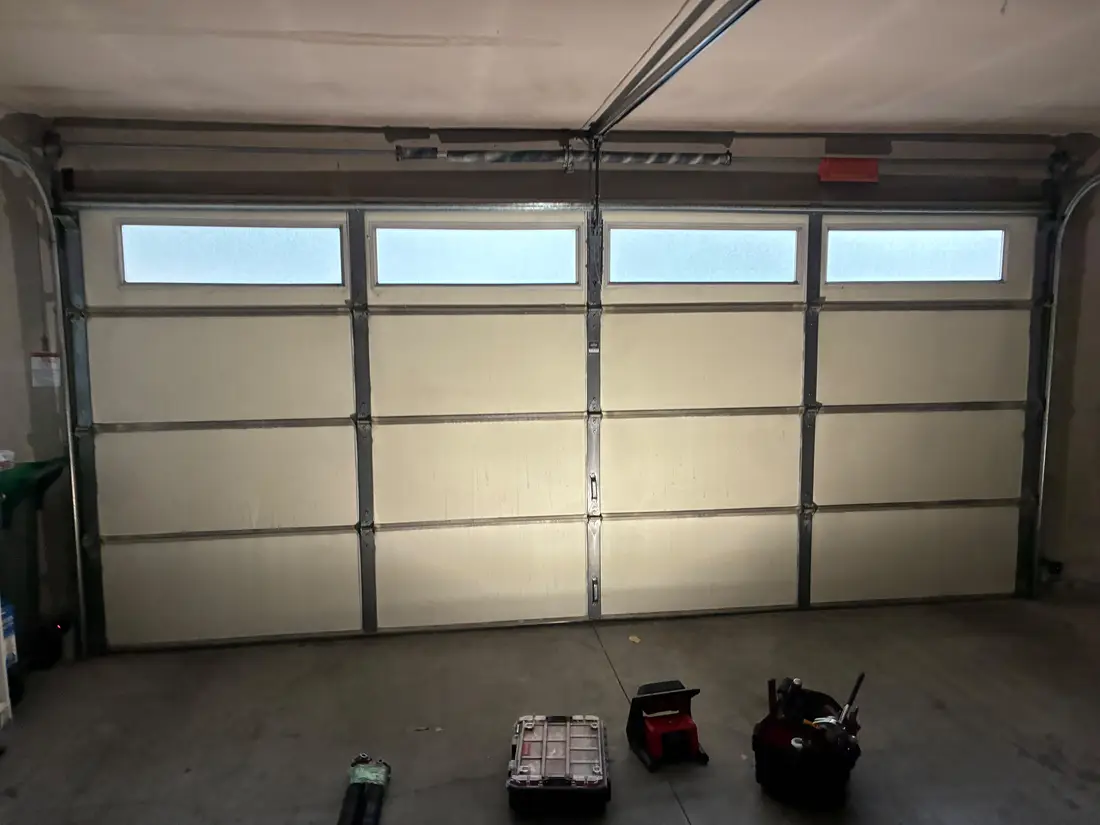
The fast answer: R-value measures how well a garage door resists heat flow — the higher the number, the better the door insulates. If your garage is attached to your home, shares a wall or ceiling with living space, or doubles as a workshop, an insulated door is usually money well spent. If the garage is detached, unheated and used for parking and storage only, a basic door plus good weather seals does most of the practical work for far less. The sections below explain how to tell which camp you are in.
What R-value actually measures
R-value is a rating of thermal resistance: how effectively a material slows heat moving through it. Every layer of the door contributes — steel skins, insulation core, even the air films on each surface — and the brochure number is the whole section's tested value, not just the foam's. Two cautions follow from that. First, R-value is measured under lab conditions; the door's real-world performance also depends on the perimeter seals, the panel joints and how squarely the door fits its opening. A high-R door with daylight showing at the corners performs like a much cheaper door. Second, doubling R-value does not halve heat loss: the savings fall steeply with the first increments of insulation and then level off, which is why the jump from no insulation to a mid-range insulated door matters far more than the jump from a good door to the top of the chart.
There is also a cousin rating, U-factor, which measures the same thing in reverse (lower is better) and is the number building codes usually cite. If one quote lists R-value and a competitor lists U-factor, ask both companies for both numbers so you compare like with like — the same discipline we recommend for whole quotes in our guide to what a new garage door costs.
The two ways doors are insulated
Polystyrene panel insulation. A rigid foam board is fitted into each door section and usually covered with a vinyl or steel backer. It is the lighter, less expensive construction, typically landing in the R-6 to R-10 range depending on thickness. It insulates honestly and keeps the door light, which is kind to springs and openers.
Polyurethane foam-injected insulation. Liquid foam is injected into the section and expands to fill every cavity, bonding to both steel skins. Per inch it insulates better — doors commonly reach R-12 to R-18 — and the bond turns each section into a stiff sandwich panel that resists denting, rattles less and feels noticeably more solid in the hand. It is the construction we fit most often on new door installations for attached garages.
A third category is worth naming so nobody sells it to you as insulation: a non-insulated door is a single sheet of steel. It is a perfectly reasonable product for a detached garage — just do not let anyone describe it as thermally efficient.
How much R-value do you actually need?
Work through three questions. Is the garage attached? A shared wall — or worse, a bedroom above the garage — means the door is part of your home's thermal envelope, and insulation pays you back in every season. How do you use the space? A workshop, gym, laundry area or hobby space in the garage argues for the higher end of the range; a parking-and-storage garage argues for moderation. What is your climate? In cold-winter states, insulation fights real, months-long cold — our Minnesota teams fit high-R polyurethane doors as the default for attached garages. In hot-summer states the same door works in reverse, keeping heat out of the garage and off the rooms beside it, which is why our Texas crews recommend insulated doors for attached garages even though heating is rarely the issue. Mild climates sit in between: a mid-range insulated door plus excellent seals is usually the sweet spot.
Insulation is only half the job: seals and fit
Heat does not only move through the door — it moves around it. The bottom seal, the perimeter weatherstripping and the panel joints decide how much air leaks, and air leakage defeats R-value faster than any foam upgrade can fix it. Stand inside your closed garage on a bright day and look for daylight at the corners and along the bottom. Replacing a flattened bottom seal and worn perimeter strips is inexpensive, and seal inspection is part of every tune-up and safety check we run. The homeowner side of seal care — what to check and how often — is covered in our annual maintenance checklist. The rule of thumb: seal first, then insulate. A well-sealed mid-range door outperforms a leaky high-R door in the real world, every time.
The benefits that are not about energy
Homeowners often buy insulation for the temperature and end up valuing the side effects more. Strength: a foam-bonded section resists the dents that thin single-skin doors collect from bikes, balls and bumper taps. Quiet: insulated doors run and close with a duller, more solid sound, and they do not rattle and oil-can in the wind the way hollow sections can. None of these benefits require the top R-value on the chart; they arrive with any genuinely insulated construction.
Can you insulate a door you already own?
Sometimes. Foam-board kits cut to fit each section exist for many steel doors, and on a sound, well-sealed door they can add a few points of R-value. Two warnings before you reach for a kit. First, added insulation adds weight — even a modest kit changes the door's balance, and a door balanced for its original weight will strain the opener and wear the springs until it is re-balanced. Springs are matched to door weight precisely, as our repair team explains on every visit, so plan on a professional balance check after any retrofit. Second, a kit cannot rescue a door whose sections are thin, rusted or poorly sealed — on an aging door, the money usually works harder as a deposit on an insulated replacement. If you are weighing exactly that choice, a tune-up visit gives you a written picture of your current door's condition before you decide anything.
Buying advice: read the quote like a technician
When quotes arrive, compare four lines, not one number: the insulation type (polystyrene or polyurethane), the stated R-value, the section construction (single-skin, insulated with a backer, or a full steel-back sandwich), and whether perimeter seals are included or extra. Ask whether the R-value quoted is the manufacturer's tested whole-section value. And keep the decision in proportion: for most attached garages, a steel-back polyurethane door in the mid-to-high R range, properly sealed and correctly sprung, is the end of the analysis. Chasing the last two points of R-value buys far less than spending the same money on fit, seals and a correctly sized opener.
Not sure what your garage actually needs? Call Eagle Garage Doors Pros at (855) 558-7767, or send the request form on our contact page — tell us whether the garage is attached and how you use it, and we will spec the door honestly, including telling you when the basic door is the right answer.