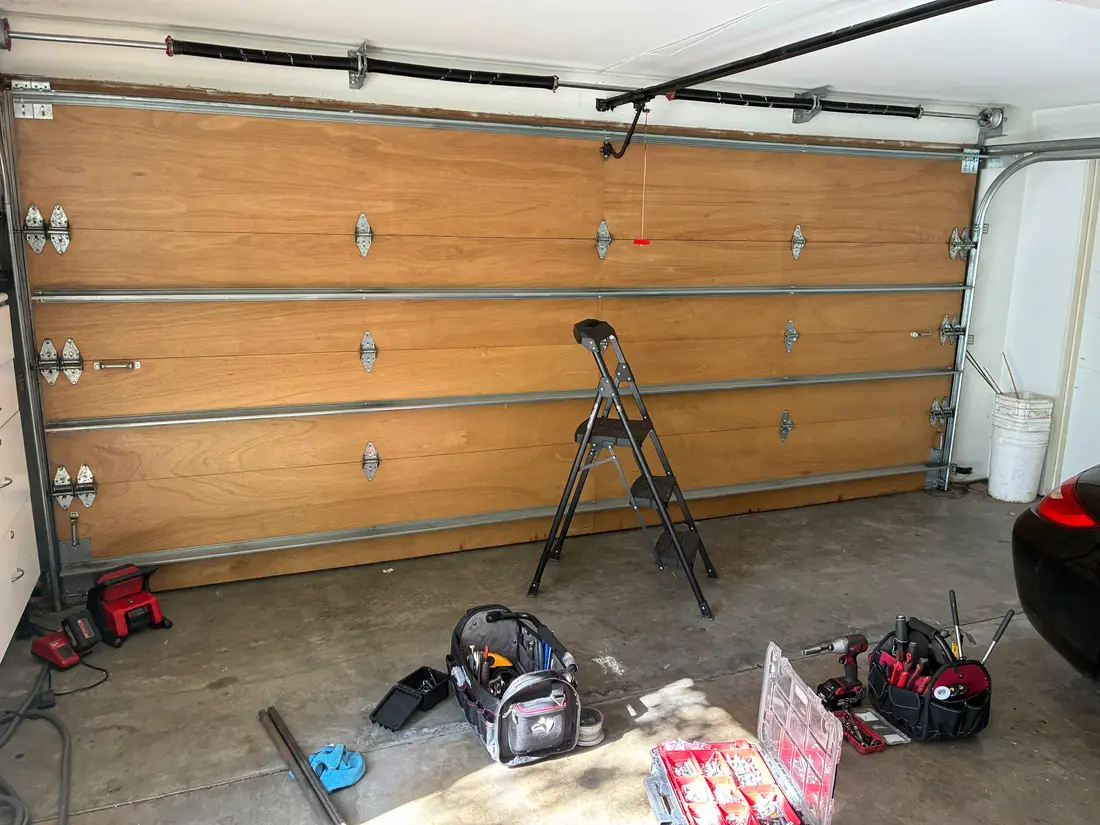
Your garage door cycles more in a month than your front door does in a year, yet it is the appliance most homeowners never maintain. This checklist splits the work honestly: what you can do safely in under an hour, and what belongs to a technician with our tune-up and safety check.
Monthly, in five minutes
Watch and listen. Stand inside the garage and run the door. New grinding, squealing, scraping or jerking is the door reporting wear — note when it happens in the cycle. Test the auto-reverse. Lay a 2×4 flat in the doorway's center and close the door. It should contact the board and reverse within two seconds. Test the photo-eyes. Start the door closing and pass a leg or box through the sensor beam: the door must stop and reverse. If either safety test fails, stop using the door automatically and call for repair.
Twice a year: lubricate the right parts
Use a silicone-based or white lithium garage-door lubricant — not standard WD-40, which is a solvent that strips more than it protects. Apply to roller bearings, hinges, the spring coils (a light pass), and the opener's chain or rail per its manual. Wipe excess so it does not drip on the car. Never lubricate plastic rollers' tracks themselves; the rollers should roll, not slide, and greasy tracks collect grit.
Annually: the hands-on inspection
Hardware: With the door closed, check that track bolts, hinge screws and bracket fasteners are snug — vibration loosens them over hundreds of cycles. Tighten with a wrench or nut driver; never touch the bolts on the bottom brackets, which sit under cable tension. Cables: Look for fraying, especially where cables meet the bottom brackets at floor level — corrosion starts there. Frays mean call a pro; cables are spring-system parts. Rollers: Steel rollers should spin freely without wobble; nylon rollers should show no cracks or flat spots. Weather seals: The bottom seal should compress evenly; daylight at any corner means gaps for water, pests and cold air. Balance: Disconnect the opener (door closed) and lift by hand. It should move easily and hold position halfway. A heavy or drifting door means the springs are losing the fight — book spring service before the snap picks the date.
The exterior matters too
Wash steel doors with mild detergent to slow rust, especially in coastal salt air; rinse and dry the bottom section where road salt and sprinkler spray collect. Touch up chips promptly — rust on a garage door starts at paint damage near the bottom edge. For wood doors, check the finish yearly; failed sealant lets moisture in and warps sections.
What to leave to a technician
Spring adjustment or replacement, cable replacement, track realignment, and bottom-bracket work all involve stored energy or precise alignment. An annual professional tune-up covers these plus the opener's force and limit calibration — the full list is on our tune-up page. Think of the split this way: you handle observation, lubrication and safety tests; we handle tension, alignment and wear parts.
Keep a simple log
Note the date of each check and anything unusual — a noise in March, a slow reverse in June. When a technician visits, that log turns guesswork into diagnosis. Doors maintained this way routinely outlast their neighbors, and their owners meet us on scheduled visits instead of emergency calls. That is the entire goal.
A note on opener care
While you are in maintenance mode, give the opener five minutes too. Check that its mounting is tight — a vibrating opener loosens its own hardware. Test the battery backup if equipped (unplug the unit and run the door once) so an outage does not surprise you. Replace remote batteries yearly whether they need it or not, and wipe the safety sensor lenses while you think of it. Finally, find the manual release and make sure every adult in the house knows how it works — the time to learn it is not during a blackout with a car to move.