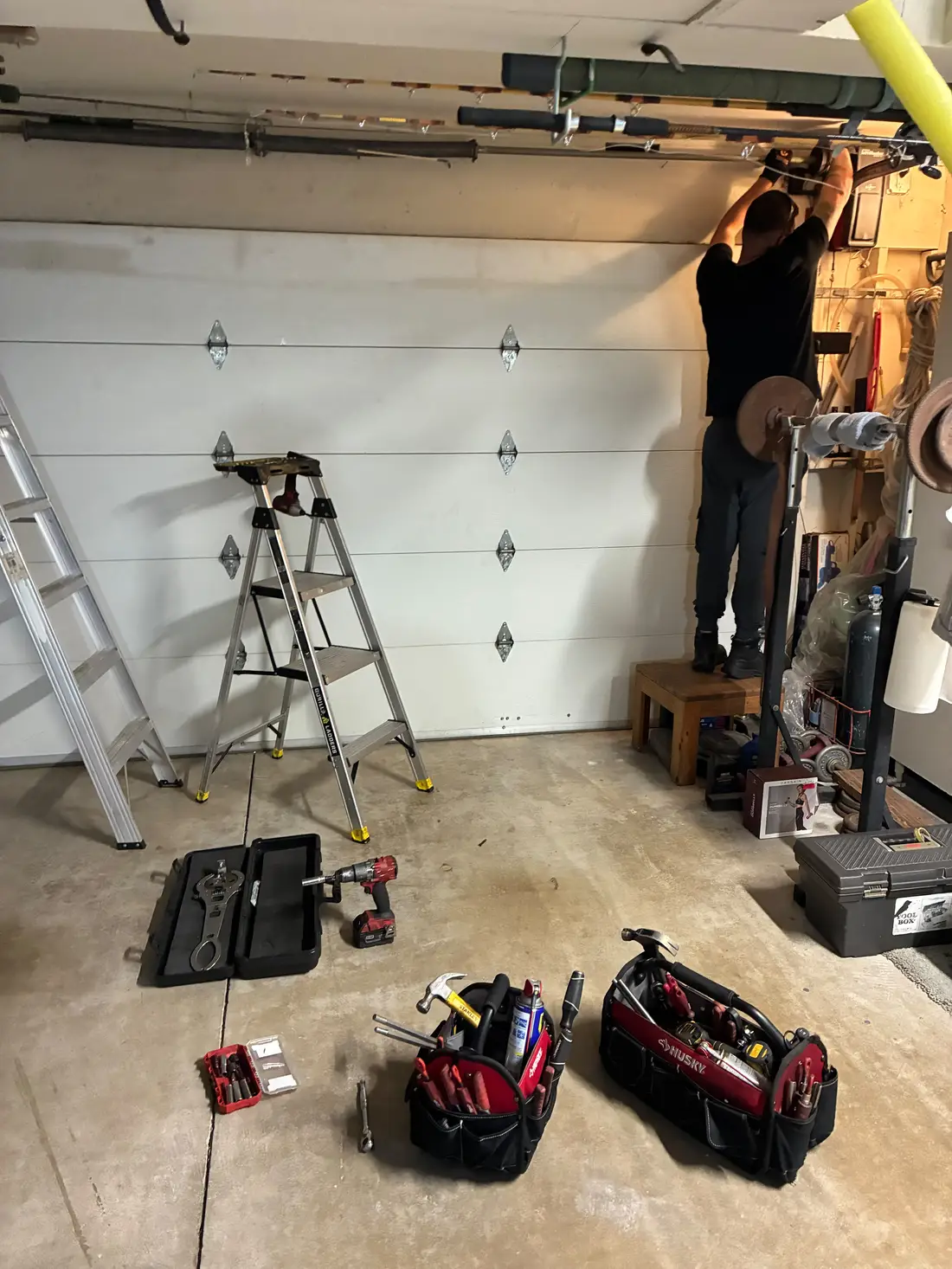
A garage door opener should last 10 to 15 years. Some failures are cheap parts; others are the unit telling you it is done. Here is how to read the signals — the same way our opener installation team does before recommending anything.
Signals that usually mean repair
1. It reverses for no reason. Almost always sensors, travel limits or a binding door — adjustments, not a new opener. 2. Remotes stopped working but the wall button works. Batteries, reprogramming or the wall console's lock feature. 3. It hums but does not move. Often a stripped drive gear or a failed start capacitor — both replaceable on many models. 4. It is loud but strong. A worn chain, dry sprocket or loose mounting; service and lubrication can quiet it considerably.
Signals that usually mean replace
5. It predates safety sensors. Openers made before 1993 lack photo-eye protection entirely. That alone justifies replacement — it is a safety device your family uses daily, and modern units add rolling-code security and battery backup. 6. The logic board is fried. After a lightning surge, boards often fail intermittently — random operation, dead radio, phantom reversals. Board replacement on an old unit rarely pencils out against a new opener with a warranty. 7. The motor is burned out or the unit is 15+ years old with a major failure. When a big component dies on an old unit, the next component is usually not far behind. 8. You need features it cannot offer. Battery backup for outage-prone areas, Wi-Fi alerts when the door is left open, or a quiet belt drive under a bedroom — if your life has outgrown the unit, replacement is a quality upgrade, not a repair.
The check that comes before either answer
Always balance-test the door first. A door with a fatigued spring makes any opener — new or old — strain, and we regularly meet "dead openers" whose real problem is a spring about to snap. Disconnect the opener and lift the door by hand: if it is heavy or drifts, fix the balance (see spring replacement) before judging the motor. Any company that quotes you an opener without touching the door by hand is skipping the most important diagnostic.
What a replacement gets you today
Modern openers bring soft-start DC motors that are gentler on door hardware, battery backup, phone control with open/close alerts, LED lighting, and rolling-code security that changes with every click. Wall-mount models free the ceiling entirely. Paired with an annual tune-up, a new opener installed on a balanced door is typically a set-it-and-forget-it appliance for the next decade-plus.
The bottom line
Repair when the failure is a wear part, a sensor or an adjustment, and the unit is young enough to deserve it. Replace when safety is outdated, the board or motor is gone, or the repair quote approaches half the installed cost of a new unit. A trustworthy technician will show you both numbers. That is the standard we hold our own repair visits to — including telling you when the answer is "your opener is fine; your spring is not."
A quick word on cost logic
Run the comparison the way we do. Price the repair honestly — part, labor, and the likelihood that a second part on an aging unit follows it within a year or two. Then price replacement installed, with its fresh warranty on parts and labor. When the repair is a third or less of replacement and the unit is under ten years old, repair usually wins. When the repair crosses half of replacement, or the unit lacks modern safety features, replacement is the better money. Any technician who will not show you both numbers side by side is selling, not advising.