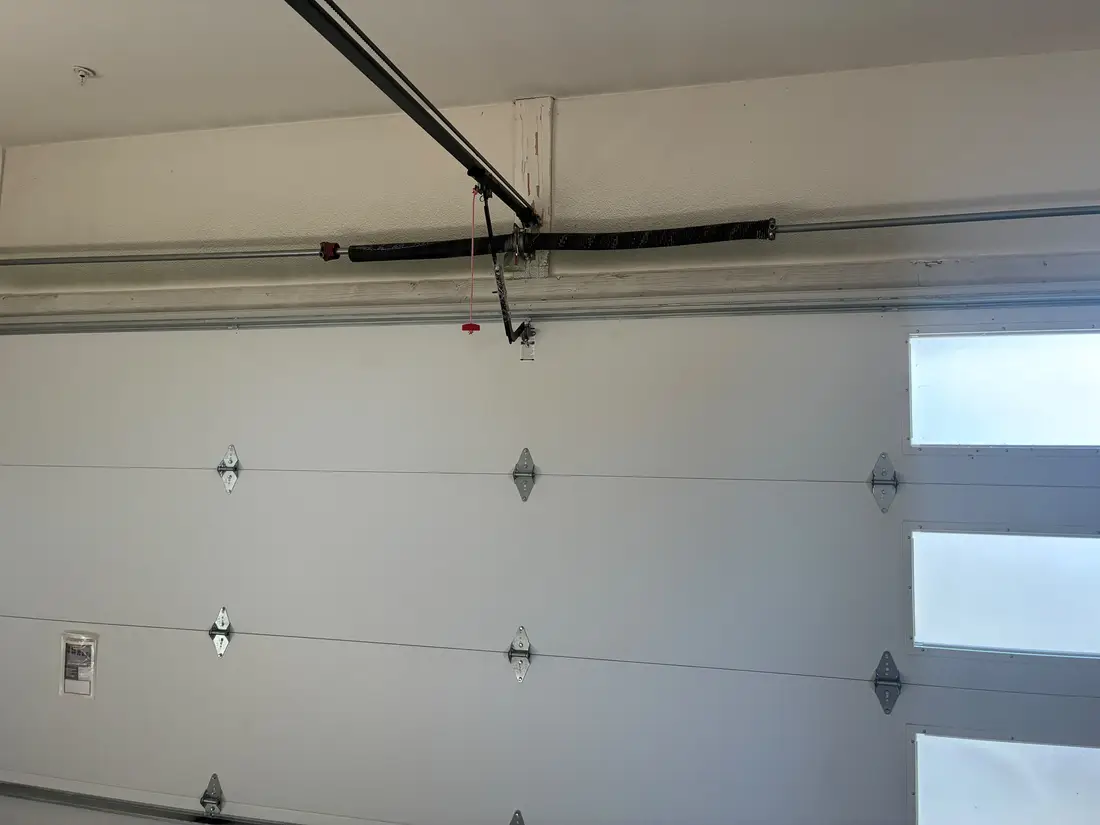
Every overhead garage door is counterbalanced by one of two spring systems. Knowing which one your door has explains how it behaves, how long it should last, and what a replacement involves. Here is the full comparison our technicians give homeowners.
How torsion springs work
Torsion springs mount on a steel shaft running across the wall above the door. As the door closes, the springs wind tighter, storing energy as torque. As the door opens, they unwind and spend that energy lifting. Because the lift is applied through cables wound on drums at both ends of the shaft, the force is even across the door's width — which is why torsion doors run smooth and stay level.
How extension springs work
Extension springs mount along each horizontal track (or above the door on some older systems) and work by stretching. Closing the door extends them; opening the door lets them contract and pull the door up through cables and pulleys. Each side lifts semi-independently, so extension systems are more prone to uneven, jerky movement as parts wear.
Lifespan and performance
Both are rated in cycles, but torsion springs generally outlast extension springs and deliver smoother, quieter travel throughout their life. Torsion systems also balance better as they age because both sides share one shaft. Extension systems tend to stretch unevenly, which racks the door and wears rollers and tracks faster — faults our repair team sees constantly on older extension-spring doors.
Safety
This is where the systems differ most. A torsion spring that breaks stays on its shaft — it unwinds with a bang but goes nowhere. An extension spring that breaks can launch off its mount, which is why safety containment cables must be threaded through extension springs: if yours do not have them, adding them is urgent, cheap insurance we install during any tune-up.
Replacement cost factors
Extension springs are cheaper parts; torsion springs cost more but are wound precisely to your door's weight and usually last longer per dollar. Labor differs too: torsion replacement involves weighing the door and calculating spring specs, while extension replacement is simpler but should still be done in pairs with new safety cables. Either way, springs are matched to the door — never swapped for "close enough" parts. See broken spring replacement for how we size them.
Should you convert extension to torsion?
A conversion replaces the extension hardware with a shaft, drums, bearings and torsion springs. It costs more than an extension replacement but buys smoother operation, longer spring life, better balance and a safer failure mode. It makes the most sense when the door itself is in good shape and you plan to stay in the home, or when extension parts are failing repeatedly. It makes less sense on a door near the end of its life — in that case, a new door ordered with a torsion system from the start is the better spend. We will run both numbers for you honestly.
How to tell which you have
Look above the closed door: a horizontal shaft with one or two tightly wound coils means torsion. Look along the tracks at ceiling height: long springs that stretch as the door closes mean extension. Either way, both systems are under high tension — leave winding, unwinding and replacement to a technician. If you are not sure of your springs' age, a balance test during a tune-up tells us how much life they likely have left.
Quick reference
Location: torsion — shaft above the door; extension — along the tracks. Motion: torsion winds; extension stretches. Balance: torsion lifts from a shared shaft, evenly; extension lifts from two independent sides. Failure mode: torsion stays on the shaft; extension needs a safety cable to be safe. Typical life: both rated in cycles, torsion generally longer in practice. Best for: torsion — most doors, especially heavy ones; extension — older, lighter doors where it is already fitted and healthy. Whichever you have, the rules are the same: matched pairs, correct sizing, and no DIY winding.