Garage door springs do not wear out quietly — but the signs are often misread until the door stops working entirely. Here are the seven signals our technicians hear about most, what each one means, and what to do when you spot them.
1. A loud bang from the garage
The signature event. A torsion spring under tension releases its energy all at once when it snaps, producing a crack or bang people describe as a gunshot, a firecracker, or something heavy falling. If you heard it and the door now misbehaves, the diagnosis is almost certainly a broken spring.
2. A visible gap in the spring
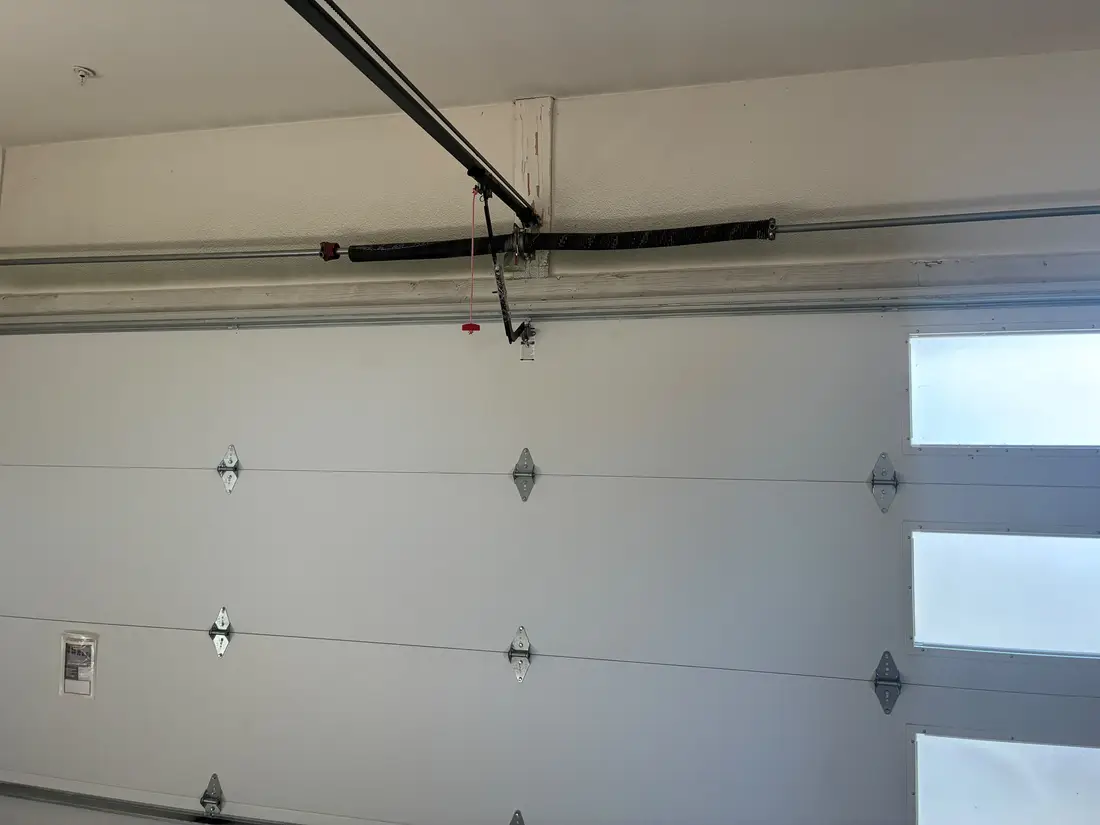
Stand inside the garage with the door closed and look at the spring on the shaft above the door. A healthy torsion spring is one continuous, tight coil. A broken one separates into two pieces with a visible gap — often two to four inches — where the coil let go. No other test is needed; the spring has failed.
3. The door feels impossibly heavy
Pull the red release cord (with the door closed) and try to lift the door by hand. With working springs, it feels light. With a broken spring, you are lifting the door's full weight — 150 to 400 pounds. If it barely budges, stop straining and reconnect nothing; the spring system needs professional spring replacement.
4. The door opens a few inches, then stops
The opener tries, manages a few inches against the dead weight, and its force protection shuts it down. Homeowners often blame the opener — but the opener is the messenger. Replacing a motor without fixing the spring just burns out the new motor, which is why our opener technicians always balance-test the door first.
5. The door lifts crooked or jerky
On a two-spring system, one broken spring leaves the other side lifting alone: the door racks to one side, binds in the tracks and may pop rollers out. Extension-spring systems show the same crooked lift when one spring fails. Stop using the door — a crooked door under power can come out of the tracks entirely.
6. Loose or hanging cables
When a spring breaks, the cables it tensions go slack. You may see a cable dangling beside the door, wound oddly on its drum, or lying on the floor. Slack cables mean the lifting system has lost its balance point — another reason not to cycle the door.
7. The top panel bows or the opener strains and reverses
An opener pulling against a dead door flexes the top section where its arm attaches; you can see the panel bow as it strains. Repeated attempts crack the panel's stile and strip the opener's gear. If you see bowing, that is your last warning before a second component fails.
What to do next
Do not try to wind, clamp or replace the spring yourself — it stores enough energy to cause severe injury, and it is the one job even experienced DIYers should skip. Keep the door closed if it is closed; if it is stuck open or crooked, keep people clear and treat it as an emergency call. A technician will replace the springs in pairs, sized to your door's weight, re-balance the system and test the safety reverse — typically in a single visit. The smart long-term move: if your remaining spring is the same age, replacing both now (as we recommend in our repair visits) costs far less than two separate emergencies.
Can a spring be "almost broken"?
Yes — and catching it then is the whole game. Springs fatigue cycle by cycle, and a spring near the end often announces itself first: the door grows heavier over a few weeks, the opener sounds more strained, or the door drifts down a few inches when left halfway during a balance check. Rust streaks on the coils and stretched, uneven coil spacing are visual warnings too. If a balance test during a tune-up shows a weakening spring, replacing it on a scheduled visit — in daylight, at regular rates, with both springs done together — is strictly better than meeting it as an emergency.